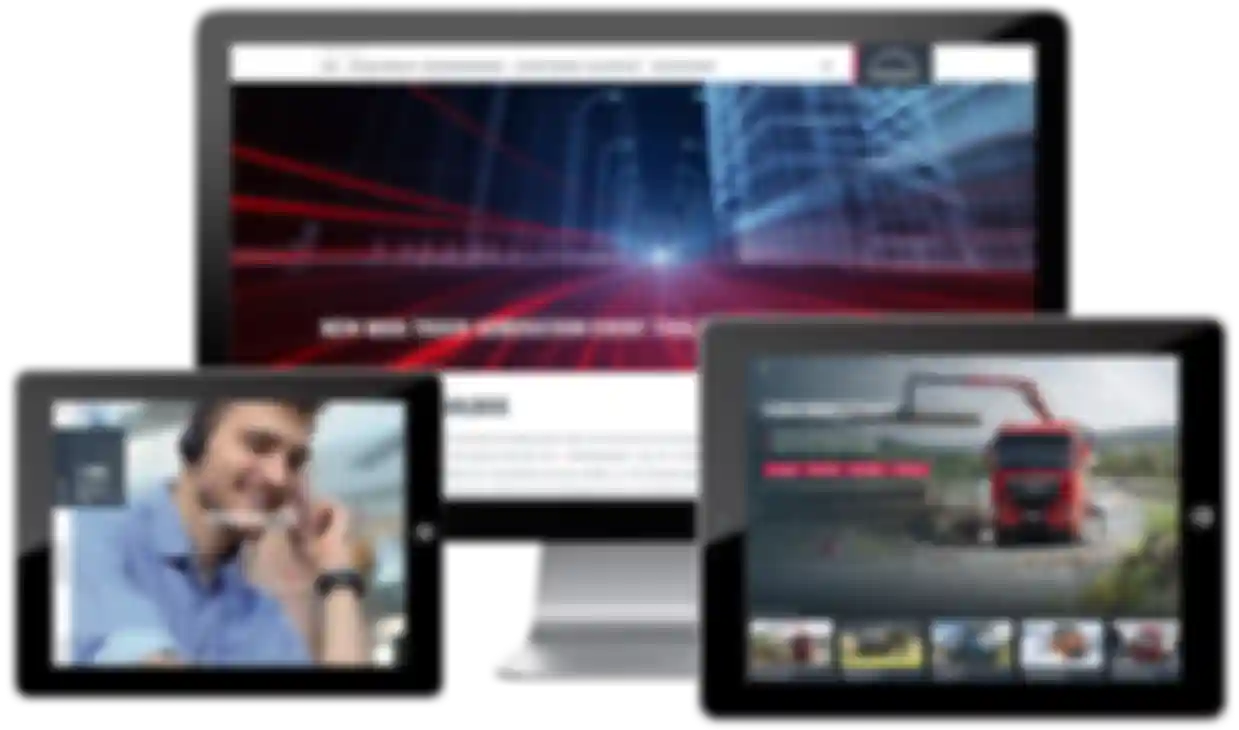
An interactive brand and product experience was created for the world premiere of the new MAN Truck Generation in Bilbao. Through various exhibits, visitors were able to explore the features, services and innovations of the new vehicles for themselves.
As the technical partner for the overall project, we were commissioned to develop a central content and translation system, several web-based touch applications, and a portal for the global reuse of the applications. The design of the overall presentation and other exhibits were not part of our scope of work.
Challenge
The content for numerous trade fair applications had to be managed centrally, made available in many languages and reliably delivered to various technical systems. In addition to our web-based applications, installations developed in Unity3D also needed to be integrated. Not only did the data structures of the applications differ – the text formatting in Unity3D was also incompatible with the HTML markup used in the CMS.
Solution
Based on TYPO3, we developed our own content and translation system. Texts, media and configurations were managed centrally within this system and delivered to the respective applications as JSON via a secure REST interface.
In addition, we programmed four progressive web apps for large touchscreens. For subsequent local events, we also created a toolbox portal through which available application variants and languages could be downloaded and further translations requested.
Content and Translation System
The custom-developed TYPO3 extension q3i_mantranslation mapped applications, content areas, texts and media within a translatable structure. A roles and permissions system separated the tasks of administration, development, editing and approval.
The DRAFT and LIVE workspaces enabled content to be prepared and checked by the editorial team first. Only after approval was the content delivered to the installations at the exhibition. To facilitate collaboration with external translators, content could be exported in a structured format and re-imported into the CMS once processed. The system was designed to support up to 20 languages.